Showing posts with label Island Paradise. Show all posts

Tuesday, March 6, 2012

The Cook Islands

The Cook Islands are a chain of 15 main islands spread out across a vast expanse of the South Pacific.  Geographically the islands are about 1800 miles north-east of New Zealand and were formed by volcanic activity.  The islands are self-governed but retain close ties with New Zealand and use the NZD as currency.

The main island of Rarotonga is a heavily touristed island and an especially popular destination for Kiwis and Australians.  The island itself is striking, with high jungle peaks rising from the sea towards the center of the island.  The  main road on Rarotonga is just 32km long and circumnavigates the coast of the entire island.  Off the coast a barrier reef protects the shoreline from the large waves, forming a lagoon that has good snorkeling in places.
Looking from the beach inland on Rarotonga
Sunrise in Rarotonga
While Rarotonga was beautiful, it lacked the remote South Pacific experience that we had envisioned, so we set off for Aitutaki, a small atoll with a breathtaking lagoon and a laid back atmosphere.  Aitutaki has about 2000 inhabitants and just a few roads so we biked the entire island in just a few hours.
Flying into Aitutaki
The vast lagoon

Aitutaki's lagoon is famous for its expansive size and color. The lagoon is roughly an equilateral triangle with each side measuring about 12km. The average depth in the lagoon is a mere 5ft, but parts go as deep as 60ft. The shallow warm water and abundance of coral means that snorkeling is good. We went on an all day lagoon tour and were able to see some impressive fish and pristine uninhabited islands on the fringe of the reef.  It was surreal being 10km from the main island but standing in water only chest deep.

A Red-Tailed Tropic Bird nesting
A Giant Clam
An inquisitive Giant Trevally
A Giant Clam with neon

Hermit Crab
Ominous dark clouds
On Aitutaki we stayed in a single floor house that doubled as a hostel. The owners were Cooks Islanders that had lived and raised a family in New Zealand and moved back to Aitutaki to retire.  A perk of our lodging was its proximity to good local food.  The cuisine in The Cook Islands is based around what is abundant: fish, tropical fruit, and root vegetables.  Enormous tuna steaks with island salads and sides featuring fruits and sweet potatoes were a staple.  Palm trees, star fruit, avocado, and mango trees lined most properties making otherwise exotic fruit readily available, which locals were happy to share.
Sunset at the volleyball field
Aitutaki was really incredible.  The stunning beauty of the lagoon, local hospitality, and delicious food, made the island a most memorable experience.

Monday, May 9, 2011

The Northern Cayes

45 minutes north of Belize City by boat is Caye Caulker, a small caye that is one of the jumping off points for those interested in snorkeling, diving, and enjoying Belize's renowned reef system. Many come to Caye Caulker to dive in the Blue Hole, the famous dive site that is a nearly perfect circular sinkhole going deep to the sea floor. But I will not be diving the Blue Hole because it costs $200USD, so instead I went snorkeling. The snorkeling was great, we spotted tons of marine life including Manatees, Black and Nassau Groupers, Tarpon, Stingrays, Nurse Sharks, and a Green Turtle.
Manatee


Green Moray Eel

Nurse Shark
Southern Stingray
Black Grouper
Green Turtle

Thursday, April 7, 2011

Utila and Little Cay

Utila is a carribean island off the Honduran coast surrounded by clear blue waters and a beautiful coral reef. Once a hang out for pirates, now Utila is inundated with backpackers learning to dive. Utila offers some of the cheapest diving in the world and has numerous dive schools to choose from.

Utila is entered around Utila Town, where most of the population on the island lives. Utila Town has one main road lining the beach and a few more that cut inland. Unfortunately scooters and golf carts are allowed to drive on the street, making walking around town noisy and hazardous.

Jumping off the dock at Rubi's Inn in Utila Harbor

Utila Harbor

On the Southwest side of Utila there are a number of Cays that are privately owned.  We (Claire, Pupi, Ben, and I) were able to rent Little Cay, an entire island for a mere $115usd per night. Little Cay has one home and one separate cabin and sleeps somewhere around 15-20 people. The house is huge with multiple decks, a huge living room, and three large private bedrooms. The Cay also has two docks and a small islet attached by a thin sandbar. The Cay itself is surrounded by good snorkeling and is a 10 minute swim away from Water Cay, a popular white sand beach.

The Little Cay main house

Looking out to Water Cay from Little Cay


Monday, February 28, 2011

The Corn Islands

Little Corn from the lighthouse
The Corn Islands are two islands off Nicaraguas Caribbean coast. The Corn Islands (Big Corn and Little Corn) offer a secluded laid back Caribbean atmosphere with ample seafood, coconut bread, and of course rum. Flying from Managua to Big Corn only took about an hour. Then a 30 minute Lancha ride took me to Little Corn where I wanted to spend the 10 days before my return to the mainland.

Little Corn is only 1.6 square kilometers. It is tiny and charming, with zero cars and no ATMs. There is one paved sidewalk that spans the main commercial drag near the port, but most trails on the islands are dirt and many wind through backyards or farmland. The biggest industries are fishing and tourism. The nearby lobster processing plant on Big Corn offers lobstermen $15USD per pound for lobster tail.


Little corn is bordered on one side by a large reef and is surrounded by submerged coral and great diving. I took the opportunity to learn how to Scuba dive with Dive Little Corn, getting my Open Water certification in 4 days and then continuing with Advanced Open Water with another 5 dives. Scuba diving was great, I saw a good variety of fish and coral, lobster, stingrays, turtles, and even nurse sharks. The highlight of my time diving was a night dive where we spotted a color changing octopus, a squid, and bioluminescence. The bioluminescence was amazing, some of which resembled a glowing string of pearls. Others were kinetic and were activated by movement, so every fin kick would illuminate dozens of bursts of light. We did a 5 minute swim underwater turning off our flashlights, using only the bioluminescence as a guide.

A Caribbean Spiny Lobster hiding
The final dive class

Little Corn had a number of great restaurants featuring local caribbean flavors and fresh caught seafood. After diving with them all day, I normally had lobster on my mind for dinner. The best I had was served with heavy amounts of garlic at Miss Bridgettes. Other highlights included Run Down, the signature local dish of Little Corn. Run Down is a coconut milk soup with fish or lobster and vegetables. And I would have never been able to muster the energy to dive three times a day without coconut bread and chicken pies from street vendors.

Miss Bridgettes Garlic Lobster

Rambo and friend selling Coconut Bread

Sunday, January 30, 2011

Sailing San Blas

I departed on a 6 day journey to Panama via the San Blas islands, an idyllic archipelago off the Panamanian coast. I booked the trip aboard the Corto, a 43 foot sail boat made in Canada and sailed by a French Captain, Michel. Michel has sailed this trip 12 times and has 7 years of experience as a Captain. There would be 8 other passengers aboard the boat.  The other passengers were 3 Irish (Paul, Kate, Noelle), 3 English (Katie, Sophie, Tor), 1 Swiss (Michael), and 1 Uruguayan (Pupi).  Everyone got along really well throughout the entire trip.

The first day and a half was spent sailing. Everyone got sea sick to varying degrees, the easiest solution was lying down and staring into the sky. While sailing Michel dropped a lure into the water and went trolling. He landed a Bonito and a Spanish Mackerel.

Fresh caught Bonito Carpacchio

After sailing for 36 straight hours from Cartagena we reached Coco Bandera, a grouping of reef protected islands to set anchor and spend a day. At Coco Bandera you could kayak to a tiny deserted island with two palm trees, or swim to a group of four slightly larger islands.

Bonfire on the beach

The Kuna sold us 5 huge spider crabs for 20usd plus two old beers.

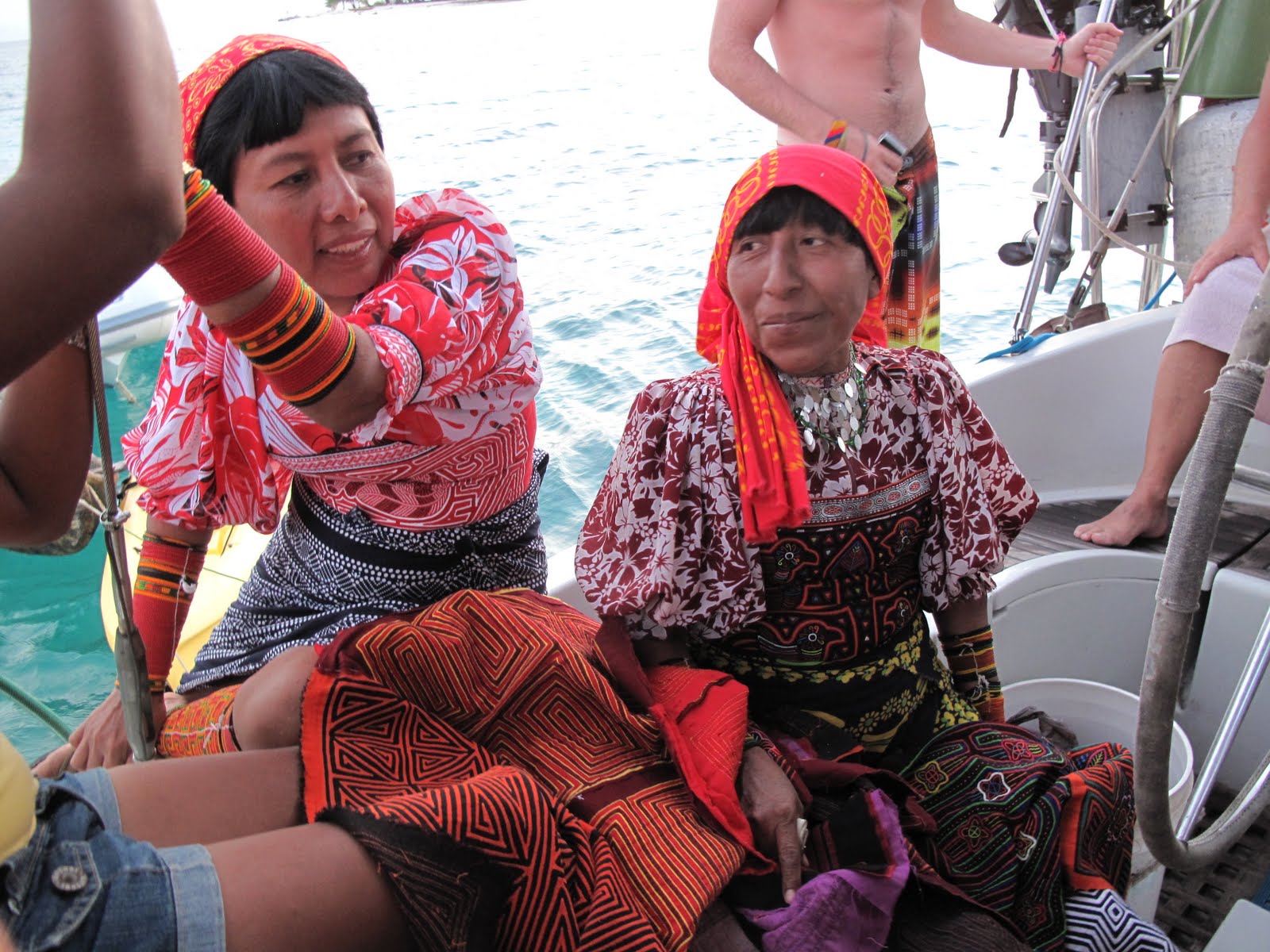
The next day we moved to another set of island and had our second encounter with the Kuna, whom are the native inhabitants to the region and still live autonomously although still being in Panama. The Kuna survive off of coconut farming, tourism, and handicrafts. The iconic palms trees which cover the San Blas were originally planted by Kuna.
Kuna women selling Molas

We also got to snorkel at a man made reef made from an old shipwreck.

On our third and final day in San Blas we got stamped into Panama at what must be the most relaxed and beautiful border post in the world. Then we went to enjoy one final afternoon lounging in perfect turquoise blue water.

Sunday, May 9, 2010

Ihla Grande


Ihla Grande is a verdant tropical island just off the Brazilian coast, a few hours south of Rio. The island has about 5000 inhabitants and 0 ATMS. There are no cars, boat is the preferred means of transport, and there are beautfil beaches accessible via long hikes. The island used to be the home of a Brazilian prison, but the prison has since been demolished. However, there are rumors of booby traps still hidden in the jungle meant to kill escaping prisoners.


Lopes Mendes Beach. About two hours away by hiking, or a 20 minute boat ride(for cheaters). The ocean is super warm.


Snorkel Trip!


Delicious island breakfast. We found a Pousada for 25 Reais (13USD pp) a night with a private hammock room.

A two hour and twenty minute hike was well worth is after getting to swim at Dios Rios Beach. Dios Rios is the town with the abandoned prison and is still a really eerie place.