Monday, February 28, 2011

The Corn Islands

Little Corn from the lighthouse
The Corn Islands are two islands off Nicaraguas Caribbean coast. The Corn Islands (Big Corn and Little Corn) offer a secluded laid back Caribbean atmosphere with ample seafood, coconut bread, and of course rum. Flying from Managua to Big Corn only took about an hour. Then a 30 minute Lancha ride took me to Little Corn where I wanted to spend the 10 days before my return to the mainland.

Little Corn is only 1.6 square kilometers. It is tiny and charming, with zero cars and no ATMs. There is one paved sidewalk that spans the main commercial drag near the port, but most trails on the islands are dirt and many wind through backyards or farmland. The biggest industries are fishing and tourism. The nearby lobster processing plant on Big Corn offers lobstermen $15USD per pound for lobster tail.


Little corn is bordered on one side by a large reef and is surrounded by submerged coral and great diving. I took the opportunity to learn how to Scuba dive with Dive Little Corn, getting my Open Water certification in 4 days and then continuing with Advanced Open Water with another 5 dives. Scuba diving was great, I saw a good variety of fish and coral, lobster, stingrays, turtles, and even nurse sharks. The highlight of my time diving was a night dive where we spotted a color changing octopus, a squid, and bioluminescence. The bioluminescence was amazing, some of which resembled a glowing string of pearls. Others were kinetic and were activated by movement, so every fin kick would illuminate dozens of bursts of light. We did a 5 minute swim underwater turning off our flashlights, using only the bioluminescence as a guide.

A Caribbean Spiny Lobster hiding
The final dive class

Little Corn had a number of great restaurants featuring local caribbean flavors and fresh caught seafood. After diving with them all day, I normally had lobster on my mind for dinner. The best I had was served with heavy amounts of garlic at Miss Bridgettes. Other highlights included Run Down, the signature local dish of Little Corn. Run Down is a coconut milk soup with fish or lobster and vegetables. And I would have never been able to muster the energy to dive three times a day without coconut bread and chicken pies from street vendors.

Miss Bridgettes Garlic Lobster

Rambo and friend selling Coconut Bread

Friday, February 18, 2011

Isla Ometepe

Nicaragua is home to the largest lake in Central America, Lago Nicaragua.  The lake is still talked about as a means to create an alternative transoceanic canal to the Panama canal.  Lago Nicaraguas position being so near the Pacific Ocean means that Bull Sharks can swim up river and now live in the lake.  Also within the lake lies Isla Ometepe, a volcanic island that features two cone shaped volcanos which rise high above the shores of the lake.
After taking an hour ferry ride I arrived in Moyagalpa, the largest town on Ometepe.  Moyogalpa makes a good base for exploring the entire island, but to get a feel for other villages on the island I went to Balgue which sits at the base of the Maderas volcano.  Maderas is nearly 1400m above sea level and meaning a 6-8 hour hike to the top and back.
The islands economy now survives through tourism, farming, and fishing. Towns are linked by infrequent buses and many unpaved roads, which is much of the charm of Ometepe.

Tuesday, February 1, 2011

The Panama Canal

A day after arriving in Panama City I took a short cab ride from the hostel to the Miraflores Locks, one of three locks on the Panama Canal. The canal is used by approximately 14,000 vessels a year. The boats are charged by size, with large cargo ships paying between 300,000 to 400,000 USD. The cheapest fare was by a man who paid 36 cents to swim the length of the canal. The boats must pay cash only in US Dollars.

The boats are lifted 75ft above sea level so the boats can sail on Gatun Lake, a man made lake which connects the locks on the Pacific and Atlantic side. After being raised to the level of Gatun Lake, the boats are then lowered back down to sea level. Standing at the Miraflores Locks you can watch cruise ships, cargo ships, catamarans, sailboats, and even a nuclear sub pass through the locks.

Sunday, January 30, 2011

Sailing San Blas

I departed on a 6 day journey to Panama via the San Blas islands, an idyllic archipelago off the Panamanian coast. I booked the trip aboard the Corto, a 43 foot sail boat made in Canada and sailed by a French Captain, Michel. Michel has sailed this trip 12 times and has 7 years of experience as a Captain. There would be 8 other passengers aboard the boat.  The other passengers were 3 Irish (Paul, Kate, Noelle), 3 English (Katie, Sophie, Tor), 1 Swiss (Michael), and 1 Uruguayan (Pupi).  Everyone got along really well throughout the entire trip.

The first day and a half was spent sailing. Everyone got sea sick to varying degrees, the easiest solution was lying down and staring into the sky. While sailing Michel dropped a lure into the water and went trolling. He landed a Bonito and a Spanish Mackerel.

Fresh caught Bonito Carpacchio

After sailing for 36 straight hours from Cartagena we reached Coco Bandera, a grouping of reef protected islands to set anchor and spend a day. At Coco Bandera you could kayak to a tiny deserted island with two palm trees, or swim to a group of four slightly larger islands.

Bonfire on the beach

The Kuna sold us 5 huge spider crabs for 20usd plus two old beers.

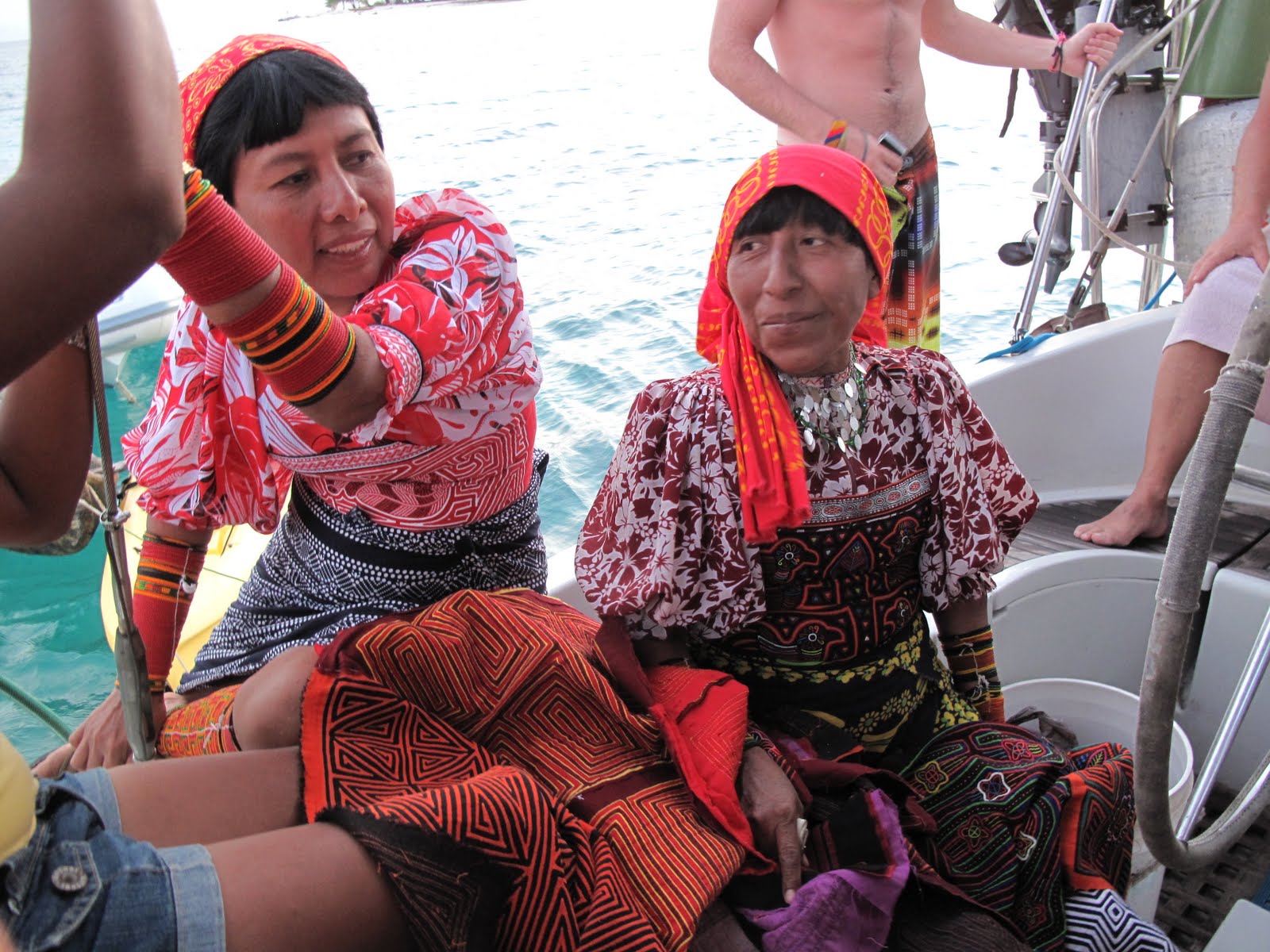
The next day we moved to another set of island and had our second encounter with the Kuna, whom are the native inhabitants to the region and still live autonomously although still being in Panama. The Kuna survive off of coconut farming, tourism, and handicrafts. The iconic palms trees which cover the San Blas were originally planted by Kuna.
Kuna women selling Molas

We also got to snorkel at a man made reef made from an old shipwreck.

On our third and final day in San Blas we got stamped into Panama at what must be the most relaxed and beautiful border post in the world. Then we went to enjoy one final afternoon lounging in perfect turquoise blue water.

Sunday, January 23, 2011

Cartagena

Cartagena is port city with a population of over a million, but nestled within the old town is a beautiful well-preserved colonial city.  Pirates like Sir Francis Drake have layed siege to the city in search of Spanish riches, and writers like Gabriel Garcia Marquez have written novels based on the romance and allure of such a beautiful place.  Today the city is a hub for tourists, each street meticulously preserved and restored. There is also a distinct Afro-Caribbean feel with music, dance, and food all heavily influenced.

Cartagena was used as the primary shipping hub for the Spanish in the exportation of gold and goods back to Spain. As such, it was attacked and sieged numerous times. The result was a well fortified city with underwater sea walls, forts, and cannons protecting an ornate and beautiful inner city.

Below are photos from Castillo de San Felipe de Barajas, the ominous Fort across the channel from the Old Town.


Seafood is abundant and local tropical fruits are everywhere.  Food choices revolve around the staples of rice, beans and plantains, mixed with the regional specialties.  On her last night here, Christine treated me to a meal at La Vitrola, a posh Cuban restaurant catering to the local elite with live jazz.

Garlic shrimp over a bed of plantain chips at La Mulata
The menu at a local juice restaurant
Arepas at a street cart
Cartagena by night.  Sweltering heat keeps the city quiet during the day but at night a cool breezes moves in.  The city seems to wake up once the sun is down, with dance performances and horse drawn carriages ushering tourists about.


Next Stop: The San Blas islands(Kuna Yala) and Central America.